

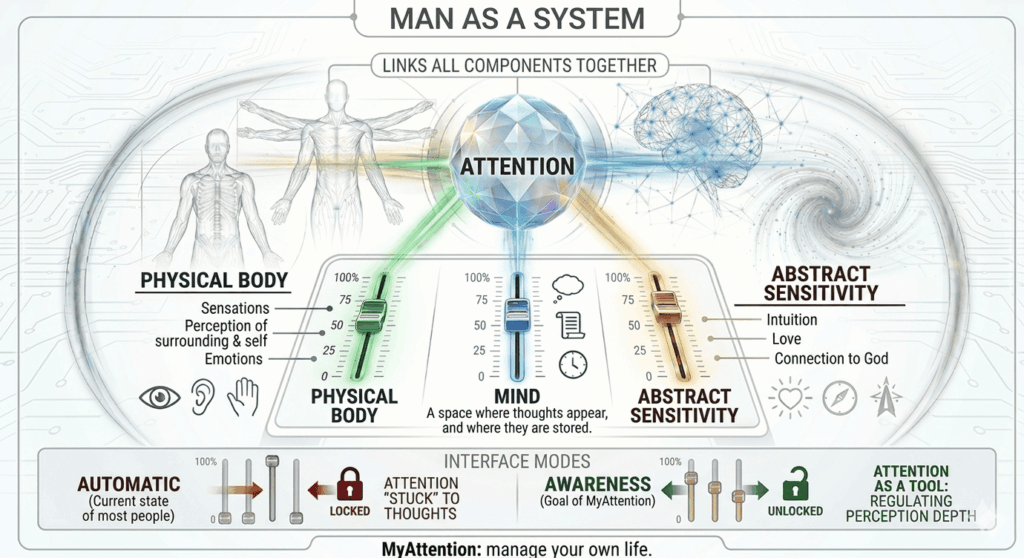
Why won't the thoughts stop?
We notice thoughts when our attention is directed toward them. When attention is withdrawn, the thought fades. The problem is not the thoughts themselves; the problem is that attention is automatically directed into them. MyAttention provides tools on how to use attention manually and how to manage your thoughts.
The essence of MyAttention
- Attention is a fundamental part of a Human: either they use it consciously, or something or someone else controls it.
- The Mind is the space where thoughts appear and where they are stored.
- Thoughts are received, not created. They disappear without attention.
- A person learns to manage attention as a skill.
- The result is mental autonomy: the management of one’s state, mind, thoughts, and perception.
Practical Benefits
The skill of using attention provides the ability to switch off the flow of thoughts, reduce anxiety, and restore the capacity to choose your thoughts, actions, and reactions.
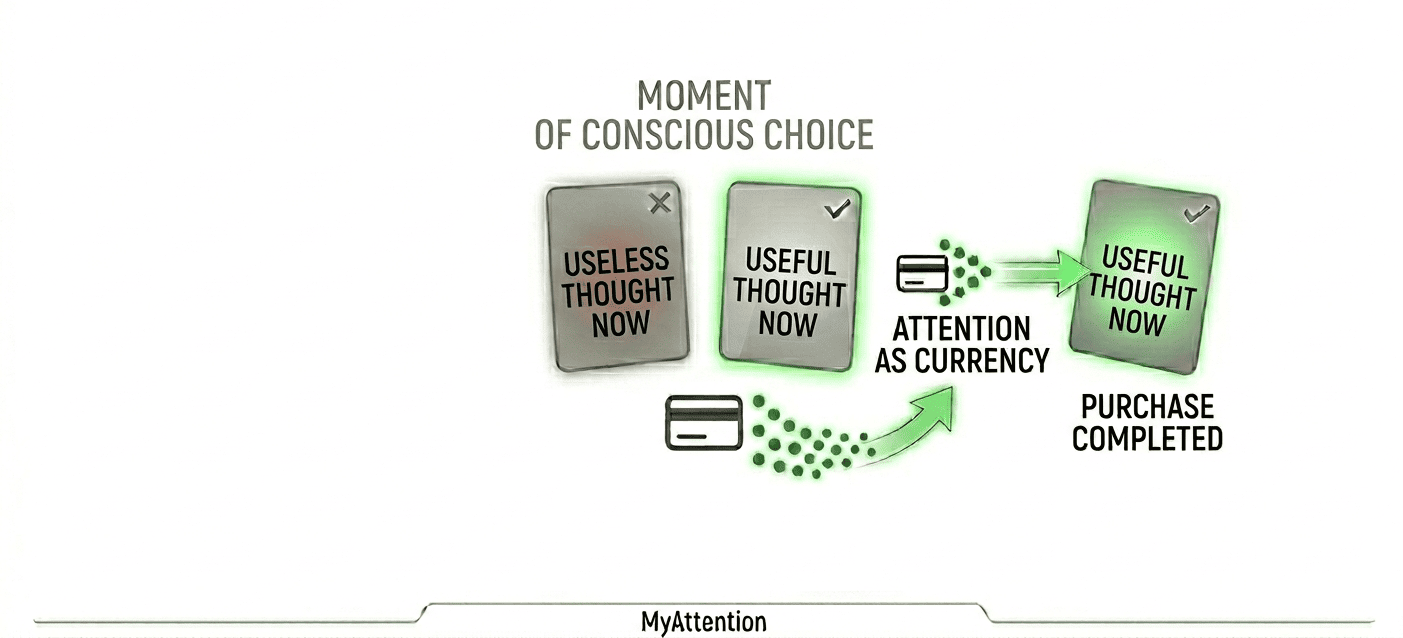
How the MyAttention method works
1. Understanding Attention
Understanding what Attention is and where it is located.
2. Attention Management
The skill and ability to use your Attention.
3. Understanding Thoughts
A deep exploration of what thoughts are and how to use them.
4. Mind and Thought Control
The mind becomes a manageable tool, not the "I".
5. Mental Autonomy
A stable state and internal control. Freedom.
People’s Stories — Real Results
After: Learned to control attention and state.
«The skill of managing attention has emerged — and it changes everything.»
After: Saw the mechanics of the mind and how to manage it.
«A fundamental understanding of a human and the mechanics of attention.»
After: Life’s course has shifted — attention became a tool.
«Practical techniques that deliver results.»
After: Deep understanding and practical mastery of attention.
«Awareness became practical, not philosophical.»
After: New abilities and directions have opened up.
«Attention as a skill works in any field.»
After: Clarity and the ability to act from stillness.
«Now I choose my thoughts — they don’t choose me.»
How MyAttention Differs from Meditation, Mindfulness, and Vipassana
| MyAttention | Traditional Meditation | Mindfulness | CBT | Vipassana |
|---|---|---|---|---|
| Attention is a tool for managing the mind, thoughts, and feelings; active use of attention | Passive observation | Returning attention to the present moment | Changing the content of thoughts | Focus on bodily sensations (scanning) |
| Thoughts vanish without attention → the person chooses their thoughts | Thoughts are observed but not managed | Noticing distractions and gentle return | Analysis of beliefs and restructuring | Observing sensations → often leads to dampening of emotions |
| The mind is a space; attention reconfigures the flow of the mind | Focus on breath/contemplation | Focus on accepting the experience | Focus on behavior and cognitions | Long practices and strict discipline |
| Goal — the technical skill of mental autonomy and managing all aspects of life | Goal — calmness and inner peace | Goal — presence | Goal — symptom reduction | Goal — «purifying» the mind; risk of emotional flatness |
| Works instantly upon using Attention; once in a lifetime is enough | Temporary effect during practice. Requires isolation. Does not solve the core issue with thoughts | Effect depends on consistency. Creates dependency on the practice itself | Effect depends on the therapist | Temporary effect and potential loss of desire for some |
Stories — In Detail
«I was living on autopilot: everything just happened on its own. During the course, I understood what a human is and how attention works. Now I see that I manage my attention, rather than it managing me. This has completely shifted my perspective on life.»
«I used to suffer from a lack of focus and constant emotional swings. After the training, I learned how to manage my attention and stabilize my state. This is something no one could teach me before.»
«The course provided not just understanding, but practices that work every single day. I perceive thoughts and the mind differently now — they have become a tool.»
Ready to try?
A short practice gives a tangible effect from the very first use of attention. Start with a free test and explore yourself.
Try the Training Get the Full Program
Before we get rid of thoughts, let's try to understand what they are. We can think and reflect, but have you tried to observe thoughts, explore them, explore the space where these thoughts appear?
Intuition is like knowing in advance.
However, it is not an exact knowledge of what exactly will happen; it appears as a certain feeling. In my opinion, the nature of intuition is not fully understood. How does a person feel it?
There are a huge number of institutions and tools designed to take your attention—political technologies, mass media, entertainment, social media—all aimed at taking your attention.
Your attention is the most valuable resource you have
Let's think of a relationship in terms of attention.
The essence of a relationship is directing one's attention to a partner and accepting Attention from a partner throughout the relationship.
Each partner gives as much...
Happiness is something that most people strive for. However, if you ask different people, everyone will define happiness in their own way. Some people will talk about what they are missing, some will talk about socially acceptable and "right" things, some will respond that it's family, children, and so on.
So, what is Happiness?
Before answering the question: “how not to get stuck in emotions?” let's look at what emotions are, how they appear and what they depend on.
You've definitely encountered emotions in your life. From joy to anger, from enthusiasm to apathy. But what is it?
Let's try to understand these concepts and what to do about these phenomena.
Let's start with addictions, which come in two types:
Biochemical Addiction:
Thought Addiction:
Despite the countless books, stories, poems, and movies about love, there remains a lack of clear understanding of what love truly is. This is perplexing. How can a phenomenon so extensively explored and discussed remain elusive in its definition? Human beings lack specific receptors or sensory organs that can definitively identify love, as we might with other sensations.
The Meaning of Life - living your life through experiencing your unique feelings, emotions, and interacting with others.
In fact, this should be the end of the article. But I will try to explain why it is so, without using religious or esoteric terminology.
Finding one's life purpose is a universal concern. Many people ask this question. When we talk about the purpose of life, it often overlaps with the concept of the meaning of life. However, if we think of it as a goal, the main goal can be to be a unique Human.
The purpose of life is to be a Human. The Meaning of life is to live your unique life as a Human being and to interact with others.
We encounter manipulation daily, and I'm certain each of us has been manipulated at some point. Let's delve into this topic to better understand it.
There are two main types of manipulation:
- When manipulation is directed at us.
- When we manipulate someone else.
Most people are usually concerned with manipulation directed at
What is the present moment? What is realization? How is realization different from mindfulness? How to get in the present moment?
Let's delve into that together, and then try to understand what we can and can't really do.
Sensitivity is based on feelings. First, let's define what it is.
Feelings are what we can feel, what we perceive with the help of receptors located in our body.
Feelings are one of the